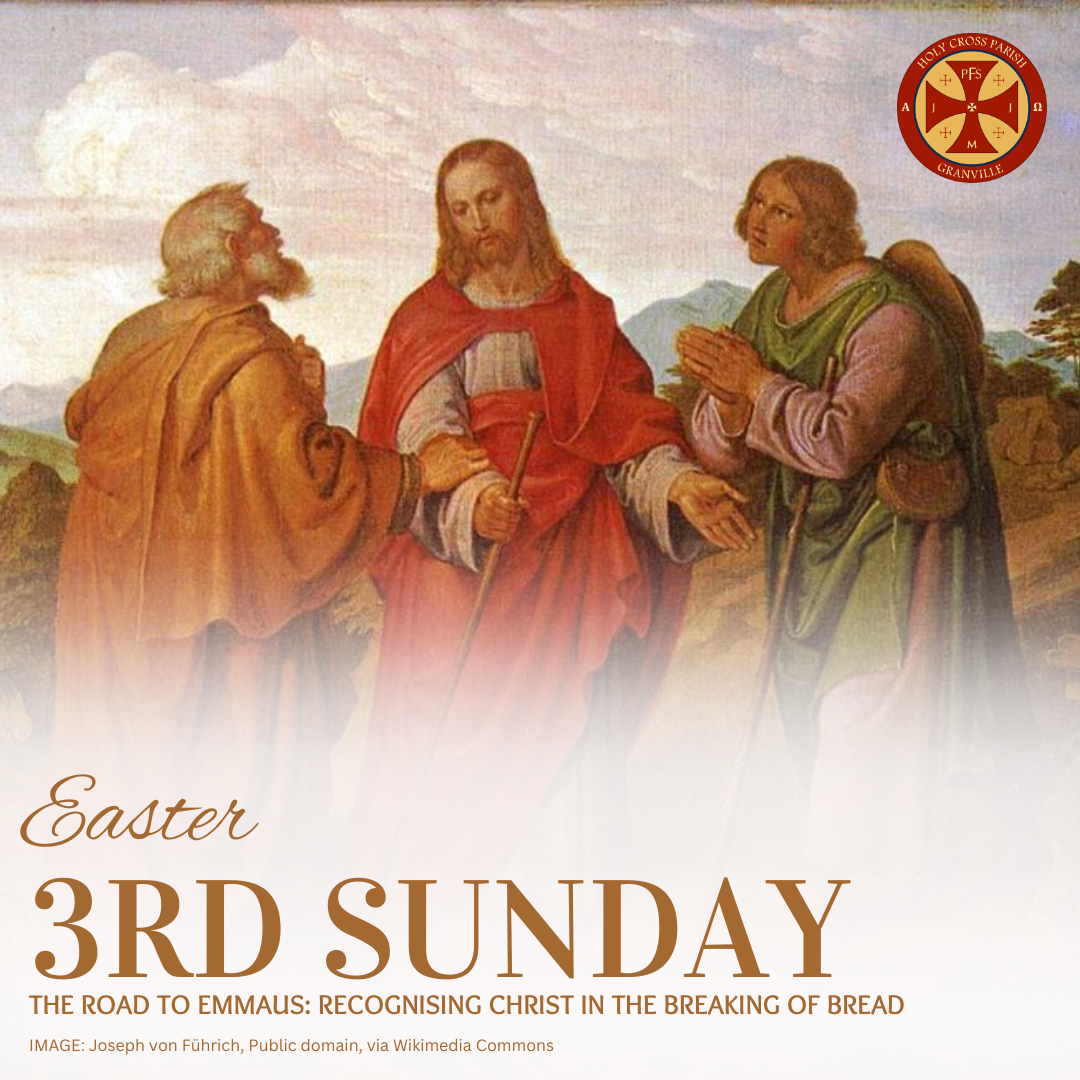
3rd Sunday of Easter, Year A
On the Third Sunday of Easter, the Gospel takes us to the road to Emmaus, where two disciples walk in sorrow and confusion. Their journey away from Jerusalem represents the soul’s struggle when faced with the apparent defeat of the Cross and the crushing of earthly expectations.
Our Lord joins them, yet “their eyes were kept from recognising him.” In this mysterious encounter, Jesus reveals Himself as the Master of both Word and Sacrament. He first begins with the “Liturgy of the Word,” interpreting the Scriptures to show that the Christ had to suffer these things to enter into His glory. He demonstrates that the Old Testament is a long, winding path that finds its definitive destination in His own Sacred Heart.
The climax of the journey occurs at the table. When He takes the bread, blesses it, breaks it, and gives it to them, “their eyes were opened.” This is a clear reference to the Holy Eucharist. In the traditional understanding, this teaches us that while the Scriptures “set our hearts on fire,” it is in the “breaking of the bread”—the Most Holy Sacrifice of the Altar—that we truly and substantially encounter the Risen Lord.
As soon as they recognise Him, He vanishes from their sight. He is no longer seen with the physical eyes of the flesh, but is now present under the sacramental veils. This Sunday challenges us to look beyond the “accidents” of our daily lives and the “bread” on the altar to see the living God. Like the disciples, our response to the Eucharist should be immediate: a return to “Jerusalem,” the Church, to testify that the Lord has truly risen and is known to us in the breaking of the bread.